Curve names
Convention and structure
Section titled “Convention and structure”Curve names always follow the same metadata structure, which makes it easy to find the exact curve you are looking for. A complete set of metadata gives exactly one search hit.
For example, pro dk wnd ec00 mwh/h cet min15 f is the wind (wnd) power (pow, not shown)
production (pro) forecast (f) for Denmark (dk) in MWh/h (mwh/h), based on the EC00
weather forecast (ec00). The curve has 15-minute frequency (min15) and time stamps in CET
(cet).
Curve names are always ordered like this, and always in lower case:
<commodity> <category 1> <price area> <category 2, 3, ...> <sources> <scenarios> <unit> <time zone> <frequency> <data type>The commodity is very often power (pow), which is never included in the name. The EUR/DKK
exchange rate has commodity currency (cur), category price (pri) and price area all:
cur pri all €/dkk cet d a.
Some curves are associated with stations, such as meteorological points, rivers or gas
terminals. The station name comes directly after the price area and may contain spaces. In
this example the station is LNG Terminal Zeebrugge:
gas inventory be lng terminal zeebrugge 1000m3 lng cet d sa.
Curves also have numeric IDs, but do not rely on them: they are not constant. Curve names are constant and unique.
Geographical names from non-Latin alphabets (for example Greek) are transcribed into the Latin alphabet. Names in the Latin alphabet with accented characters either keep the accents, or map them to standard Latin characters:
ø→oü→uä→aß→ss
Curve names are UTF-8 encoded, so special characters in units (for example €/mwh, °c) are
represented correctly.
Abbreviations
Section titled “Abbreviations”Each abbreviation is an attribute of the curve and belongs to one of these groups. The curve attribute endpoints return all possible values with descriptions.
| Group | Examples | Endpoint |
|---|---|---|
| Area | de (Germany), no3 (Norway price zone 3) |
/curve-attributes/areas |
| Category | spv (solar photovoltaic), nuc (nuclear) |
/curve-attributes/categories |
| Commodity | pow (power), gas, coa (coal) |
/curve-attributes/commodities |
| Curve type | time_series, instances |
/curve-attributes/curve-types |
| Data type | a (actuals), f (forecast), s (backcast) |
/curve-attributes/data-types |
| Frequency | min15 (every 15 minutes), w (weekly) |
/curve-attributes/frequencies |
| Scenario | low, high (low/high assumptions) |
/curve-attributes/scenarios |
| Source | ec00 (ECMWF at 00:00 UTC) |
/curve-attributes/sources |
| Station | weather station, power plant | /curve-attributes/stations |
| Time zone | cet (Central European Time) |
/curve-attributes/time-zones |
| Unit | mw (megawatt) |
/curve-attributes/units |
For example, to list all areas:
curl -H "Authorization: Bearer $TOKEN" \ https://data-forecasts.volue.com/api/v1/timeseries/curve-attributes/areasCategory descriptions
Section titled “Category descriptions”Some categories need more explanation than their name gives.
- COM: Scheduled commercial flow. Day-ahead nominated commercial exchanges. Does not include intraday flows.
- COM DA: Market coupling flow. Implicit exchange output from the price coupling calculation that directly reflects day-ahead price formation.
- FWD: Forward model output or input. Covers 4 years ahead.
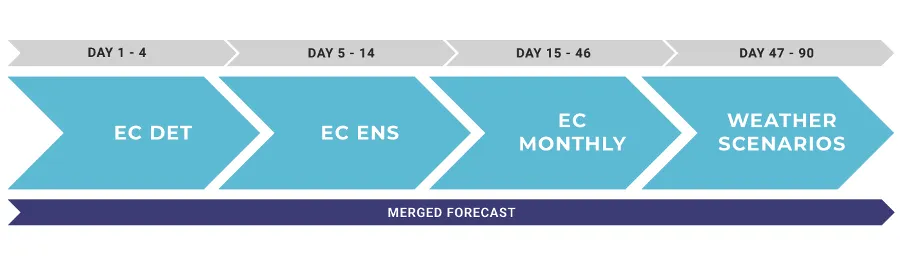
- MERGED: A series of forecast curves joined into one forecast curve. Our best guess based on the individual weather forecasts we provide (for example the EC00, EC00Ens and ECMonthly spot price forecasts, and weather scenarios). See the figure below.
- PHY: The measured physical flow of energy between neighbouring bidding zones or price areas on a given border.
- PTDF: Power Transfer Distribution Factor. How much 1 MWh of net exchange to/from a flow-based hub affects the cross-border exchanges.
- RAM: Remaining available margin. The free margin for every critical branch in the flow-based domain. Directly linked to category PTDF.
- SHADOW NTC: The capacity explicitly auctioned by TSOs/JAO if the market coupling algorithm fails in the CWE flow-based region.
- SPOT: Related to actual spot market results or our InstantSpot model. Covers up to 90 days ahead.